The Burma Rifles
The Burma Rifles came into being in April 1937 following the separation of Burma from India, when the 20th Burma Rifles, the junior line infantry regiment of the Indian Army, was transferred from the Indian establishment to the Government of Burma. Being no longer part of the Indian Establishment, the number “20” was dropped from the regiment title. At the time of transfer, there were four regular infantry battalions.

Courtesy of the Simon Jervis Collection.
The 20th Burma Rifles had in 1922 been formed from the 70th Burma Rifles and 85th Burman Rifles, as part of the reorganisation of the Indian Army. Both regiments had been raised during World War I and battalions saw service in Mesopotamia, Aden and Egypt. A territorial battalion, the 11th Battalion, 20th Burma Rifles, was also formed in 1922. In 1937, this too was transferred from the Indian establishment, becoming 11th Battalion, The Burma Rifles.
Originally composed of Burmans, Karens, Kachins and Chins with some Gurkhas, despite the protests of experienced officers the recruitment of Burmans was stopped in 1927. The rationale was that the Burmese did not make good soldiers but the failure to recruit them alienated the regiment from the Burmese population, which saw the regiment as just another part of the occupying British forces.
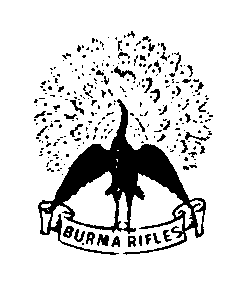 Before the separation of Burma from India, the infantry units which came to be included in the Burma Army, the Burma Rifles and the Burma Military Police, were officered exclusively by British regular offices of the Indian Army. From 1st April 1937, officers for the Burma Rifles, the Burma Frontier Force and the B.M.P. were found by the secondment of British Service officers and Indian Army officers for a tour of four years, extensible to five. All officers were placed at the disposal of the G.O.C. Burma who decided the officer postings between the three forces (Burma Rifles, B.F..F and B.M..P). Apart from British Regular officers, Governor's Commissioned Officers (G.C.O.s), the equivalent in Burma of Viceroy's Commissioned Officers in India, served with the battalions of the Burma Rifles and the B.F.F. The G.C.O.s retained the Indian ranks of subedar-major, subedar and jemadar.
Following the outbreak of war in 1939, many officers serving with British infantry battalions in Burma and those serving with the Burma Forces were posted away to help with the expansion of the British and Indian Armies. Replacements for these officers and additional officers to support the expansion of the Burma Army were found by the appointment of officers from the Army in Burma Reserve of Officers (ABRO).
The battalions were organised into four rifle companies and between 1923 and 1937 two companies were composed of Karens with one each of Chins and Kachins. The working language was Urdu, as in the Indian Army, though many British officers learned Burmese and the tribal dialects.
The outbreak of war in Europe stimulated a steady expansion of the regiment from 1939. First came an additional territorial battalion, the 12th (Lower Burma) Battalion on 1st October 1939. The reluctance to recruit Burmans was overcome and both the 5th and 6th Battalions were formed from cadres of the existing regular battalions and given Burman companies. The 7th (Burma Police) Battalion was raised in November 1940 from a nucleus of men from the Burma Police and the Burma Military Police, around half the men being Burmese and Karen with the rest being Indians who had settled in Burma. The 8th (Frontier Force) Battalion, formed in October 1940, was composed of Sikhs and Punjabi Mussalmans serving with the Burma Frontier Force. The two battalions of the Burma Territorial Force, 11th and 12th, were embodied as regulars and the 9th (Reserve) and 10th (Training) Battalions were formed in July 1941. The 13th and 14th (Shan States) Battalions were formed on 1st December 1939 and 15th May 1941 respectively. There were few experienced men to draw on to fuel this expansion and the despite the increase in numbers, overall effectiveness was reduced.
The Battalions
1st Battalion
Formed 1st April 1937 from the 1st Battalion, 20th Burma Rifles.
2nd Battalion
Formed 1st April 1937 from the 2nd Battalion, 20th Burma Rifles.
3rd Battalion
Formed 1st April 1937 from the 3rd Battalion, 20th Burma Rifles (Kachin).
4th Battalion
Formed 1st April 1937 from the 10th Battalion, 20th Burma Rifles.
5th Battalion
Raised 1st April 1940, by milking the regular battalions; one company was Burmese.
6th Battalion
Raised 15th February 1941, by milking the regular battalions; one company was Burmese.
7th (Burma Police) Battalion
Raised 1st November 1940, at Mandalay from a nucleus of men of the Burma Police and Burma Military Police; composition was Gurkha, Sikh, Punjabi Mussalman and Burmese.
8th (Frontier Force) Battalion
Raised 1st October 1940, composed of Sikhs and Punjabi Mussalmans serving with the Burma Frontier Force.
9th (Reserve) Battalion
Formed on 24th July 1941, a holding unit with an establishment of some two thousand and responsible for training recruits who passed out of the 10th Battalion.
10th (Training) Battalion
Raised on 1st July 1941, a training unit at Maymyo with an establishment of around 2,500.
Burma Rifles Battalions of the Burma Territorial Force
11th (Territorial) Battalion
Formed on 1st April 1937 from 11th (Territorial) Battalion, 20th Burma Rifles, Indian Territorial Force.
12th (Lower Burma) Battalion
Raised on 1st October 1939, composed of Burmese and Karens. Headquarters and two companies raised partly by transfer of men from the 11th Battalion. Two further companies were raised in 1940.
13th (Shan States) Battalion
Raised on 1st December 1939, to guard RAF aerodromes; officered by Shans, Karens and Burmese - the men being mainly Shans.
14th (Shan States) Battalion
Raised 15th May 1941, to guard RAF aerodromes; officered by Shans, Karens and Burmese - the men being mainly Shans.
All battalions suffered casualties, desertions and the transfer of men during the campaign of 1942. By early April 1942, for instance, all the Burmans and many Karens had deserted from the 7th Battalion, the remaining 250 or so men were mostly Indians and Gurkhas. The 2nd Battalion suffered some desertions but those remaining were steadfast. Summaries of the eventual fate of the battalions of the regiment are listed below:
The 1st Battalion, Burma Rifles was reduced in strength to around 50% of establishment by 25th March 1942. The battalion crossed into India on 15th May 1942, camping at Palel and then Milestone 109 on the Manipur Road. The battalion was still active on 20th May 1942 but was disbanded soon after.
The 2nd Battalion reached India in relatively good shape and for a short time formed the nucleus of a Composite Burma Rifles Battalion, which also held the remaining men of the 1st, 4th, 5th, 9th and 10th Battalions. The battalion was reinstated to provide reconnaissance troops for Wingate's Chindits and went on to serve with distinction in this role on the First and Second Chindit Operations.
The 3rd Battalion lost many men before and at the Sittang Bridge and was withdrawn, on Line of Communication duties, to Mandalay which was reached around 11th March 1942. Here the decision to disband the battalion was taken and the remaining men dispersed - the Kachin company reinforced the 5th Battalion, the Chins went to the 2nd Battalion and the balance, around 40 Karens, went to the 4th Battalion. The 3rd Battalion was formally disbanded on 12th April 1942 at Mandalay.
The 4th Battalion reached Burma in May. Of the 450 men setting out from Mandalay, some 345 reached India. The battalion was disbanded on 6th June 1942 at Milestone 107 on the Manipur Road, India. 75 men returned to Burma and 261 joined other units - the majority going to the Composite Battalion, Burma Rifles which was later redesignated the 2nd Battalion.
The 5th Battalion reached India with a strength of around 50 all ranks and followers, most of the Kachins having left to join the Kachin Levies and the Chins to join the Chin Levies. The battalion was officially disbanded in India on 20th May 1942.
The 6th Battalion was reduced in strength to around that of a company and during March or April 1942 was formed into a Garrison Company of Karens.
The 7th Battalion reached India in May and for a time formed a composite battalion with the 8th Battalion at Hoshiarpur during June and July 1942, re-fitting under Central Command. In September 1942, the Gurkhas and Kumaonis of the battalion were formed with men of the 8th battalion into 1st Battalion, The Burma Regiment.
The wholly Indian 8th Battalion was reduced to around 250 men by early April but this was mainly due to battle casualties. The 8th fought well in the early battles and was regarded as the best of the Burma Rifles battalions. The battalion underwent re-fitting, forming a composite battalion with the 7th Battalion at Hoshiarpur during June and July 1942, under Central Command. In September 1942, the Punjabis and Sikhs were formed, with men of the 7th Battalion, into 1st Battalion, The Burma Regiment.
The 9th Battalion continued to administer replacements and send them to the remaining Burma Rifles battalions throughout the retreat. The battalion was active in this role up until at least the end of April 1942.
The 10th Battalion was "wasted" out and on the retreat to India served as Line of Communication Troops, continuing to supply (barely) trained replacements to the 9th Battalion.
The 11th Battalion served as Line of Communication Troops and suffered from many desertions. The battalion was amalgamated with the remainder of the 12th Battalion in late April 1942. On 5th May 1942, all ranks were given the choice of going on to India or being disembodied (released from service). Three Karen riflemen remained and accompanied the three British Officers to India.
The 12th Battalion also served as Line of Communication Troops and, after having come under the command of the 11th Battalion in late April 1942 and much reduced by desertions, reached Indaw on May 4th. The next day, the remaining men were paid off because as Territorials they were not required to serve outside Burma. A small party reached India on May 17th and 42 officers and men joined the Burma Army Details Camp at Hoshiarpur on 4th June.
The 13th Battalion war diaries survive only for January and February 1942. The battalion served as Line of Communication troops until disbanded on 15th April 1942.
By 18th April, the 14th Battalion had been reduced through desertion to around 100 men and by the 26th April it effectively ceased to exist. Only a tiny party consisting of the battalion CO, two officers, two NCOs and two other ranks reported to 1st Burma Division in India on 13th June 1942.
The men of the Burma Rifles who reached India were given the option of returning home, with three months’ pay, a rifle and 50 rounds of ammunition. Many did so but 500 Karens, Chins and Kachins stayed on, many serving with the 2nd Battalion in reconnaissance platoons and sections attached to the Chindit columns. Others, including Indians and Gurkhas, went on to form The Burma Regiment or acted elsewhere as scouts and guides.
The Burma Rifles re-emerged in 1945 when the British created a new, interim Burma Army to be handed over to the new Burma government at independence. The 2nd Battalion was reformed as a regular infantry battalion in 1945. A new 1st Battalion was reconstituted from former Burman soldiers in July 1945. The 3rd, 4th, 5th and 6th Battalions, Burma Rifles were raised between December 1945 and August 1947 and were composed entirely of Burmans, mainly volunteers from the former Patriotic Burma Forces (P.B.F.) which had at first fought on the Japanese side against the British but later offered resistance to the Japanese during the closing stages of the war. These new battalions of the interim Burma Army should be seen as separate entities from their colonial predecessors. The story of the new battalions is told here.
1 December 2018