F.F.7, Burma Frontier Force
A number of two company or column Burma Frontier Force mobile detachments were formed hastily in January and February 1942 to assist in guarding the oil facilities near Rangoon against a surprise Japanese attack. One of these was F.F.7, formed sometime in late January or early February1942, after the Japanese attack on Kawkareik on 20th January.[1] [2] [3]
The commanding officer, Major G.R.F. Jenney and one of the column commanders, Captain H.E.W. Braund, were from the Burma Frontier Force Junior Leaders School initially located at Thamakan, Southern Shan States on the Taunggyi - Kalaw road.[4] [5] The school was formed in the autumn of 1941 to train N.C.O.s and G.C.O.s (Governor's Commissioned Officers) for the Burma Army. The school moved to Kutkai in the Northern Shan States in December 1941 because of the unhealthy climate at Thamakan. Sometime after 20th January 1942, the Junior Leaders School at Kutkai was closed. Jenney and Braund moved to Pyawbwe, the location of the Reserve Battalion, Burma Frontier Force, to equip F.F.7. They were joined by the commander of the second column, Lieutenant C.A. McDowall who recalled that only three days were allowed to form the unit as it was urgently needed in the South. It had been intended that F.F.7 would be a three column unit but as some detachments did not arrive in time it was formed with a Headquarters detachment and two infantry columns. As McDowall had been commissioned earlier than Braund he became second in command.[6] [7]
Braund remembered the columns were made up of a mix of Chins and Burma Gurkhas however McDowall recalls his column was all Kachins.[8] While F.F.7 was able to equip with weapons, it was not able to get anywhere near sufficient quantities of ammunition for many of the weapons such as Thompson sub-machine guns, mortars and even pistols.[9] McDowall’s column, with Subedar Zau Gaung, was armed with a single Bren gun, a few Thompson sub-machine guns and the rest rifles. Some training was undertaken to familiarise the men with each other. Otherwise the men were poorly trained and had no experience.[10]
Orders were then received to join the 17th Indian Infantry Division which by now was falling back towards the Sittang River. However by the time F.F.7 arrived in the operational area the situation had deteriorated further. There was a fear that the Japanese would attack from Moulmein into the Hanthawaddy District with the object of taking the oil refineries at Syriam, Seikkyi and Thilwa and advancing on Rangoon from the South-East.[11] The task of F.F.7 was now to assist in the protection of the oil refineries from a Japanese parachute or amphibious attack aimed at capturing them intact.[12] F.F.7 spent only a day under the command of the 17th Indian Infantry Division during which it took the opportunity to recover from the train journey to the front and to hold a conference with the 1st Battalion, West Yorkshire Regiment. It then changed role from that of reconnaissance to infantry.
By around 18th February 1942, F.F.7 was part of a force which included ‘A’ Company of the 1st Battalion, The Gloucestershire Regiment and some 300 Burma Military Police of the Mandalay Battalion under the command of Lieutenant H.J.M Lindsay.[13] [14] The force’s role was to guard the approaches to the oil facilities at Syriam from the sea.[15] The Gloucesters company had moved to Syriam on 1st February 1942 and was commanded by the Gloucesters company commander, Major G.W.V. Ladds, who took command of all troops in the area. A few days after deployment to Syriam, Ladds had six platoons of Burma Military Police and Burma Frontier Force placed under his command. The Burma Frontier Force platoons would have been F.F.7.[16] The 1st Battalion, West Yorkshire Regiment arrived at Rangoon from India on 29th January 1942. For a short time the battalion also assisted in the protection of the area. Braund's column devised coordinated patrols with this battalion however it was taken away on 18th February to form part of Pegu Force.[17]
F.F.7 mounted wide ranging patrols with the Gloucester's company and the Burma Military Police. McDowall relates how the unit spent two days marching around Hanthawaddy before digging in three miles West of Thongla and 30 miles East of Syriam. The plan was for a thin screen of Burma Military Police to act as coast watchers, with small detachments at 30 mile intervals. On seeing a Japanese landing, the B.M.P. were to report back immediately. The F.F.7 columns were placed a few miles apart, in a central location, ready to respond and drive the Japanese back into the sea.[18] However following the Sittang Bridge disaster and the Japanese drive through Pegu and on towards Rangoon, F.F.7 fell back in close defence of the refineries which had been prepared for demolition.[19]
During this time F.F.7 underwent a minor reorganisation. The mule transport had proved to be useless and the unfortunate animals were shot. A few trucks were scrounged together with a car to act as a runabout for McDowall. The unit continued without a doctor. Small patrols were mounted and whilst there was little news it was clear that the military and civilian situation was deteriorating. Indian civilians began to gather around McDowall’s position to seek safety from the local Burmans. After ten days, F.F.7 was ordered to withdraw on to Syriam. [20] The 17th Indian Infantry Division had been shattered at the Sittang Bridge and the Japanese had driven through Pegu and were moving towards Rangoon. F.F.7 fell back in close defence of the refineries.[21]
By now it was early March and with the Japanese expected in Rangoon any day, orders were issued to F.F.7. As the Japanese approached, the refineries were to be demolished, following which F.F.7 was to make its way through the city and to join up with the general withdrawal northwards using launches of the Irrawaddy Flotilla Company to travel via the Twante Canal to Prome. In the event it seems only one column from F.F.7, under Captain R.C. Walker, remained to join the Army in its retreat, eventually reaching Mandalay.[22] [23]
The final orders issued were that F.F.7, less Walker’s men, with other units and men of the oil company were to be evacuated by sea. In anticipation of this the local force commander, Major Ladds had secured two launches from the Irrawaddy Flotilla Company, intending to evacuate all but his company of Gloucesters on the launches out to ships waiting down river. On 7th March, the order to destroy the facilities was given. McDowall's column was withdrawn to cover the embarkation of the evacuees. Braund's column remained dug-in at Syriam. At noon, the first of the hundreds of storage tanks were blown up, initiating a growing scene of flames and huge pyres of smoke. At 15:00, Braund moved his men off to the embarkation point where they found a jumble of abandoned vehicles, stores and mules. Braund's men destroyed everything, even shooting the mules. When this distasteful job was done they boarded their launch and headed for the waiting ships. Heading off down river, the ships headed for Calcutta where they arrived without incident four days later, on 11th March.[24]
On landing at Calcutta, F.F.7 moved into camp at Barrackpore. Two days later they entrained for Shillong and quartered at Elephant Falls camp where a mix of various Burma Army elements had collected under the command of Lt. Colonel R. Cook, commander of the Kokine Battalion, Burma Frontier Force.[25] [26]
In April, the Indian and Kachin troops of F.F.7 under Jenney and McDowall were ordered to join with some of Lt. Colonel Cook’s men to form a reorganised battalion now officially called the Kokine Garrison Battalion. This reorganisation took place on 20th April 1942 with Cook as Commanding Officer, Jenney as second in command and McDowall as a company commander and Adjutant.[27] Captain Braund had been approached to take the Chins of F.F.7 into the Chin Hills to join the Levy operations being put into place there. He and his men were quietly separated from the others at Elephant Falls to prepare for this move and on 9th May 1942, Braund and his men left by motor transport for Gauhati where they entrained for Dimapur. Braund took with him one G.C.O., 48 other ranks and three non-combatants. At Dimapur, he met with Brigadier A. Felix-Williams, commanding Levy operations in the Chin Hills.[28] The unit moved afterward to Tiddim and reported to Lt. Colonel F.W. Haswell, commanding the Chin Levies.[29] [30]
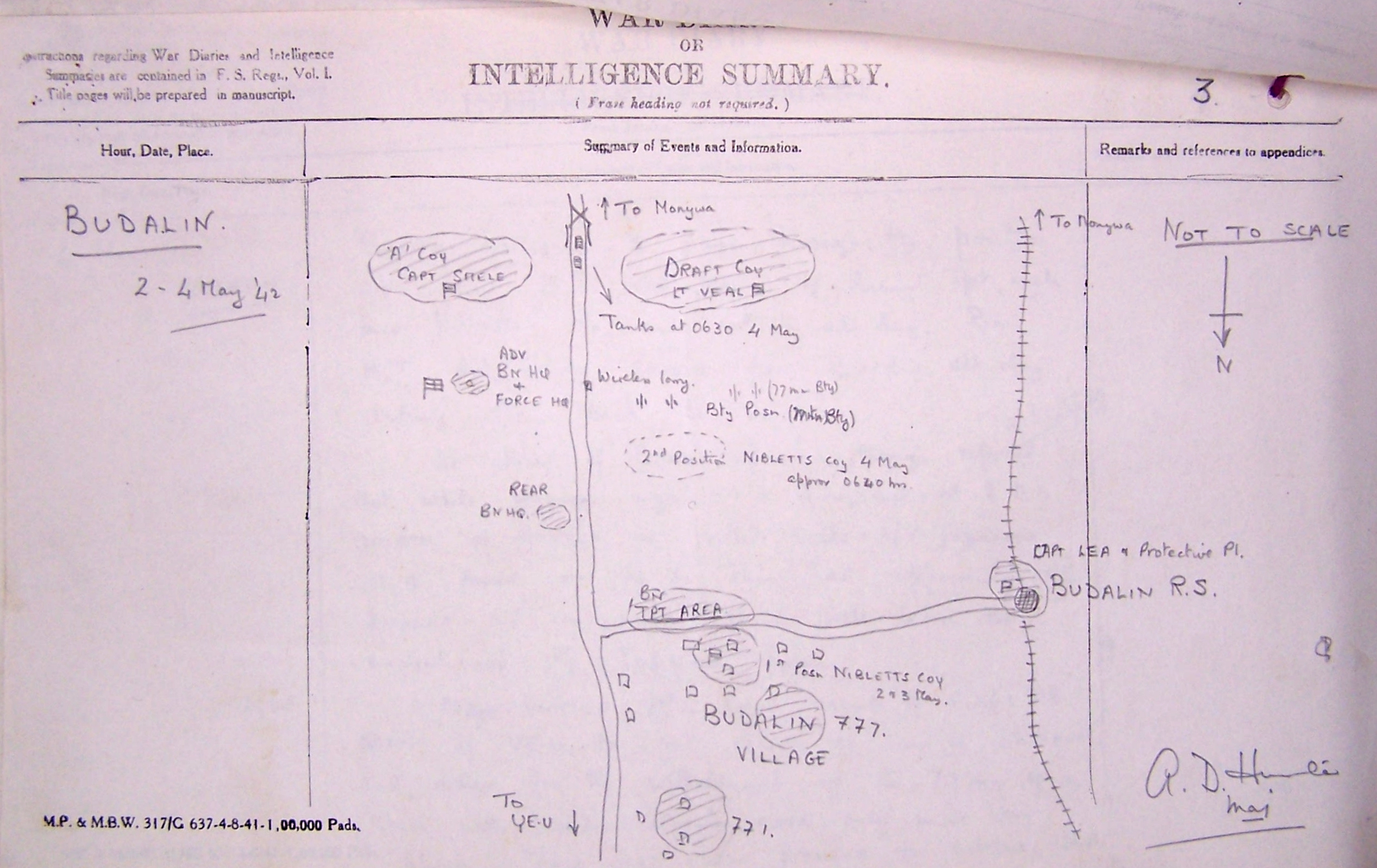
F.F.1 and F.F.7 at Budalin 2nd/4th May 1942 (1st Glosters War Diary WO 172/861)
Click image to open full size in new window
Meanwhile in Burma, the F.F.7 column under Captain Walker appears to have remained in being although there is little in the surviving records to describe this unit's history. This incarnation of F.F.7 is mentioned first in the war diary of the 1st Burma Corps when orders were issued for certain F.F. detachments to make their way to Yenangyaung to be reorganised. This order was dated 3rd April 1942.[31]
The unit is next mentioned in connection with the fighting at and around Monywa at the end of April. Monywa was held by a detachment of the 1st Battalion, The Gloucestershire Regiment and the river patrol of Royal Marines, Force “Viper”. Moving with Burcorps Headquarters, F.F.1 under the command of Major D.R. Turner arrived at Sangon, 16 miles to the North of Monywa on 30th April.[32] The small garrison at Monywa came under heavy fire from across the Chindwin River that evening. That night F.F.1 was sent by Burcorps to bolster the Monywa garrison. The next morning however, under the cover of heavy fire and intense air activity, the Japanese successfully crossed the river and secured a foothold in Monywa. Being no more than 250 strong and with no heavy weapons, the combined garrison was forced to withdraw to high ground about two miles north of the town.
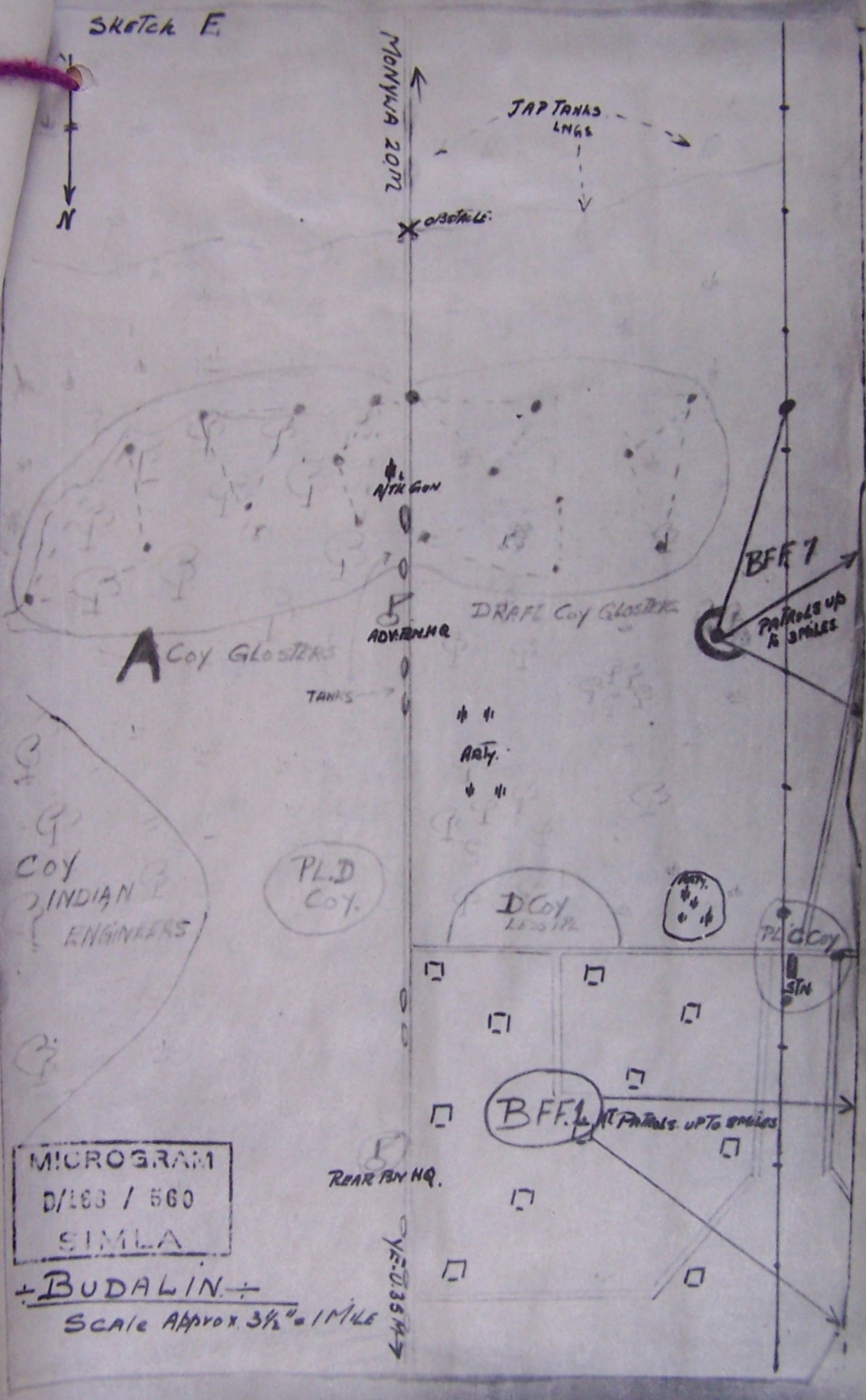
F.F.1 and F.F.7 at Budalin 2nd/4th May 1942 (1st Glosters War Diary WO 172/861)
Click image to open full size in new window
The detachment of Gloucesters and F.F.1 withdrew again and by 2nd May were in an area North of Alon on the Monywa-Yeu road. That evening, the remainder of the Gloucesters, with an F.F.7 column under command arrived and together with some mountain artillery and a few anti-tank guns were formed into a composite force under the command of the Gloucesters’ Commanding Officer, Lt. Colonel Bagot and known as “Bagot” Force. This force was directed to delay the Japanese for as long as possible whilst the 1st Burma Infantry Division completed its withdrawal from Monywa and took up positions around Budalin astride the road and railway to Yeu. F.F.1 was at the rear of the position, with orders to patrol to the West and North out to about eight miles. F.F.7 was placed on the right flank with orders to patrol out to three miles. F.F.1 and F.F.7 remained with “Bagot” Force until it was dissolved around Yeu. On the evening of 3rd May tanks of the 2nd Royal Tank Regiment withdrew on to the Budalin position and harboured behind the forward troops of “Bagot” Force. In the early hours of 4th May, the Commanding Officer of F.F.7 reported enemy movement on his front and that he had withdrawn his column to Budalin. Here he was ordered to hold a gap between two of the Gloucesters’ companies. Before dawn a small force of Japanese supported by three tanks attempted to dislodge the Force. However they were beaten off. At 06:30 orders were received for “Bagot” Force to withdraw to Yeu. A section of mountain guns and F.F.1 provided rearguard cover. Following the successful withdrawal of the force, F.F.1 was ordered to rejoin Frontier Force Headquarters. Presumably F.F.7 joined them. Both columns joined the 1st Burma Infantry Brigade on 6th May for the march to India from Pyu Gaing through Pantha to Tamu.[33]
On reaching India, on 28th May 1942, F.F.1 and F.F.7 left the 1st Burma Infantry Brigade to join the Burma Frontier Force Camp at milestone 107 on the Tamu-Manipur road where they were disbanded. The officers and men entered the pool of Burma Frontier Force and Burma Military Police.[34]
[1] “Distinctly I Remember: a personal story of Burma”, Braund, H. E. W., Wren (1972)
[2] "Some Were Lucky, The War in and Around Burma as Seen By C.A. McDowall", MSS EUR C417
[3] Braund relates events prior to the forming of F.F.7, the last of which was the Japanese attack on Kawkareik which occurred on 20th January 1942. According to Braund F.F.7 was formed after this date and before the end of January. F.F.6 was also formed at this time and in February deployed to the Pegu sector as part of Pegu Force. Note that Braund refers to "a number of F.F.s" being formed at this time so it is also possible that F.F.8 and F.F.9 were also formed during this period. McDowall recalls that he collected men for F.F.7 on 3rd February 1942 and “set out for war”.
[4] George Robert Frederick Jenney, born, 21st February 1909. Commissioned as 2nd Lt. to the Unattached List, 31st January 1929. As Captain, attached to the 11th Sikh Regiment from 22nd February 1931. Appointed to the Indian Army as 2nd Lt. (AI 252), 22nd February 1931. Promoted to Lieutenant, 30th April 1932. Served North-West Frontier of India (Mohmand), 1933. Served North-West Frontier, 1937. Seconded and served as Assistant Commandant with the 1st Rangoon Battalion, Burma Military Police, 22nd November 1937. Promoted to Captain, 31st January 1938. Served with the 7th (Burma Police) Battalion, The Burma Rifles from the battalion's formation, 1st November 1940. Served as acting Major, 1st January 1941 to 31st March 1941. Temporary Major from 1st April 1941. Adjutant, the 7th (Burma Police) Battalion, The Burma Rifles, January 1941 to September ? 1941. Commanded the Junior Leaders Training School at Kutkai, September? 1941 to January 1942. Formed F.F.7, Burma Frontier Force at Pywabye and became the Commanding Officer, January 1942 to March 1942. Evacuated by sea from Rangoon to Calcutta with F.F.7, Burma Frontier Force, early March 1942. Appointed second-in-command of the Kokine Garrison Battalion, Burma Frontier Force on formation from elements of the Kokine Battalion and F.F.7, Burma Frontier Force. 20th April 1942. As temporary Lt. Colonel, Commanding Officer of the 2nd Battalion, The Sikh Light Infantry, 1945 to 1946. As Captain (temporary Lt.
Colonel), promoted to Major, 31st January 1946. As Major, second in command of the 2nd Battalion, The Sikh Light Infantry, January 1946 to 1st April 1946. As war substantive Major, temporary Lt. Colonel, and later, Major, served with The Sikh Light Infantry, April 1946 to October 1946. Granted the honorary rank of Lt. Colonel, 8th December 1948. As Major (honorary Lt. Colonel) (45036) from Special List (ex Indian Army) retired, made Major, retaining the honorary rank of Lt. Colonel, in the Devon Regiment, Regular Army Reserve of Officers, 1st January 1949. As Major (honorary Lt. Colonel) (45036), Regular Army Reserve of Officers retired, having exceeded the age limit, 2nd September 1959. Died, Surrey,1st January 1986 ("Distinctly I Remember", H. Braund, Wren (1972); "History of The 7th Burma Police Bn: The Burma Rifles, 1940-1942"; "M&R, A Regimental History of the Sikh Light Infantry, 1941-1947", Hookway, J (ed, Backington (1999); "War Services of British and Indian Officers of the Indian Army 1941", Savannah (2004); British Army List; Burma Defence Services List July 1941; Indian Army List; London Gazette; War Diary of the Kokine Garrison Battalion, WO 172/691).
[5] Harold Ernest Wilton Braund, born, 26th November 1913. Joined Steel Brothers in London, February 1932. Sailed for Burma, June 1934. Joined the Militia Company, The King's Own Yorkshire Light Infantry as Cadet, 21st November 1940. Emergency Commission from Cadet to the General List as 2nd Lt. (189597), 28th April 1941. Joined the Northern Shan States Battalion, Burma Frontier Force at Lashio as Assistant Commandant, 5th May 1941. Column Commander, F.F.7, January 1942 to May 1942. War substantive Lieutenant, temporary Captain, 14th March 1942. Served with the Chin Levies, May 1942 to April 1945. Promoted war substantive Captain, 1st April 1943. As Captain, Chin Hills Levies, awarded the Military Cross, gazetted 16th December 1943 , his citation follows:
Unit: Chin Hills Levies
Brigade: Chin Hills Levies
Corps: 4th Corps
Date of Recommendation: 26th January 1943
Action for which recommended :- Captain H.E.W. BRAUND has served in the Chin Levies since May 1942 and has always been stationed in the F.D.L’s which he has never left during that period.
Of late months he has been in constant contact with the enemy, and has led many offensive patrols into the KALEMYO Area.
On December 24th 1942 he led a small Levy raid on TAHAN, inflicting a number of casualties on the enemy, although considerably outnumbered.
He has been indefatigable in his efforts to make a success of the Chin Levies under his Command [sic], and by his great personal courage and example, has greatly increased the morale and offensive spirit of the Levies, during a very difficult period.
This officer is highly deserving of the Award of the Order of The British Empire Medal (Military). [Amended to the Military Cross]
Recommended by: Area Commander, Chin Hills Levies
Signed By: G.A.P. Scones, Lieutenant-General Commanding IV Corps; N. Irwin, Lieut-General, General Officer Commanding-in-Chief, Eastern Army
Retired from the Army, January 1946. Married Maxine Velma Strong, Bombay, 1946. Worked for Steel Brothers associate, The Attock Oil Company in Rawalpindi, 1946 to 1966?. Awarded the O.B.E, 13th June 1959. Retired to Australia, late 1960s?. Died, 1st January 1988 ("Distinctly I Remember", H. Braund, Wren (1972); Ancestry.co.uk; British Army List; Burma Army List 1943; FindMyPast; London Gazette).
[6] "Some Were Lucky, The War in and Around Burma as Seen By C.A. McDowall", MSS EUR C417
[7] Christopher Arnold McDowall, born, 21st April 1914. Commissioned as 2nd Lt., ABRO (ABRO 50), 10th November 1939. Attended the first course held at the Maymyo Officer Cadet Training Unit, 1939. Appointed to the Burma Frontier Force, 1940. Appointed Assistant Commandant, the Bhamo Battalion, Burma Frontier Force, 8th August 1940. Worked for Blackwood Ralli & Company Limited, rice merchants, pre-war. Promoted to Lieutenant, 19th October 1941. As Captain, Column Commander, F.F.7, Burma Frontier Force, February 1942 to 20th April 1942. Temporary Captain from 14th March 1942. Served with the Kokine Garrison Battalion, Burma Frontier Force as Commander 'A' Company (Kachins) and Adjutant, 20th April 1942 to 1st October 1942. Appointed Staff Captain, the 2nd Burma Brigade, 1st October 1942. Attended Quetta Staff College, January 1943 to July 1943. Transferred to the Headquarters, Indian Expeditionary Force in Bombay from 22nd August 1943. Served on the Headquarters of XXXIII Indian Corps as Deputy Assistant Quartermaster General (M), Military Landing Officer (M.L.O.), 1943 to 1st January 1944. Attached to the Headquarters of the 36th British Infantry Division, 1944. Appointed Assistant Quartermaster General (Plans), XXXIII Indian Corps at Poona, February 1944. Appointed Assistant Adjutant & Quartermaster General, Headquarters of the 19th Indian Infantry Division, 14th November 1944. As 2nd Lt. (war substantive Major, temporary Lieutenant Colonel), attached to Headquarters XXXIII Indian Corps, awarded O.B.E., gazetted, 13th September 1945, for which the recommendation reads:
Corps: 33 IND CORPS
Unit: A.B.R.O., lately attached H.Q. 33 Ind Corps as A.Q.M.G. (Now A.A.&Q.M.G. 19 Ind Div)
Date of Recommendation: 23rd December 1944
Action for which recommended :- ASSAM – BURMA FRONTIER, 16 August to 15 Nov 1944.
This officer has shown outstanding ability and devotion to duty during the operations on the TIDDIM road and down the KABAW valley. On him has rested the responsibility for all supplies reaching the forward troops and by his carefull staff work and never flagging energy he has carried out all his duties with notable success.
Recommended by: Lt. Gen. Sir M.G.N. STOPFORD, K.B.E., C.B., D.S.O., M.C., Commander, 33 Ind Corps
Signed By: Lt. Gen W.J. Slim, G.O.C. Fourteenth Army; Lt. Gen [unreadable] , C-in-C Allied Land Forces SEA.
As temporary Lt. Colonel, The Burma Regiment, Mentioned in Despatches, gazetted, 10th January 1946. Employed Bombay Burma Trading Corporation, 1946 to 1961 ("Some Were Lucky, The War in and Around Burma as Seen By C.A. McDowall", MSS EUR C417; "Distinctly I Remember", H. Braund, Wren (1972); ABRO Appointments, Anglo-Burmese Library; Burma Army List; Burma Army List 1943; Burma Army List October 1940; London Gazette; Thacker's Directory 1941; WO 373/80/20; War Diary of the Kokine Garrison Battalion, WO 172/691).
[8] Braund; McDowall
[9] Braund
[10] McDowall
[11] McDowall
[12] Braund
[13] “Burma Invaded 1942”, Enriquez C.M. (2013)
[14] Hugh John Mainwaring Lindsay, born, 7th July 1907. Discharged at his own request from the Honorable Artillery Company Infantry Battalion, 23rd November 1925. Worked for the Indo-Burma Petroleum Company, 1937. Worked for Steel Brothers, pre-war. Commissioned as 2nd Lt., ABRO (ABRO 96), 7th March 1940. Served with the Burma Military Police, 1940-42. Married, 1941. Promoted to Lieutenant, 5th November 1941. Assistant Commandant, the Mandalay Battalion, Burma Military Police, February 1942 to May 1942. Commanded the detachment of the Mandalay Battalion, Burma Military Police on coast watching duty in the Hanthawaddy District, 4th February 1942 to 7th March 1942. Having been transferred to the battalion, arrived with the 2nd Battalion, The Burma Rifles, 5th November 1943. Part of the 2nd Battalion, The Burma Rifles that served with the first Chindit Operation, 1943. As Lt.Colonel, relinquished his duties as Deputy Secretary, Government of Burma, Defence and External Affairs Department, 31st December 1945. Transferred from the Indo-Burma Petroleum Company to the Burmah Oil Company, post war. Granted the honorary rank of Major on release from military service, 25th March 1946. Travelled from Liverpool to Rangoon on board the S.S. "Worcestershire", departing, 29th July 1946. Returned to Burma from Digboi and took up post as Manager, Chauk, 1952. Retired from Burmah Oil Company, from the post of Manager, Chauk and lived in Fleet, Hampshire, 1959. Attended the
"Indigenous Forces Luncheon", 4th October 1963. Died, Hampshire, 26th December 1991 ("Distinctly I Remember", H. Braund, Wren (1972); “Burma Invaded 1942”, Enriquez C.M. (2013); Ancestry.co.uk; Anglo-Burmese Library - Chindits; Burma Army List October 1940; Burma Defence Services List July 1941; Burma Army List 1943; Eulogy - Ancestry.co.uk; Thacker's Directory 1939; War Diary of the 2nd Burma Rifles, WO 172/2658).
[15] “Indian Armed Forces in World War II, The Retreat from Burma 1941-42”, Prasad, B, Orient Longmans (1954); McDowall
[16] “Narrative of the Burma Campaign, 1 Glosters”, War Diary of the 1st Battalion, The Gloucestershire Regiment, WO 172/861
[17] Official History; Braund
[18] McDowall
[19] Braund
[20] McDowall
[21] Braund
[22] “Burma Frontier Force”, G.G. Pryce, WO 203/5697
[23] Richard Caunce Walker
[24] Braund; WO 172/861. McDowall has the trip to Calcutta taking five days.
[25] Robert Cook, born, 11th November 1893. As a Trooper, served with C Squadron, 1/2nd Surrey Yeomanry in the United Kingdom, Gallipoli, Egypt and the Western Front, 1914 to March 1905. Served in ranks, 3 years, 245 days, mobilised with the Territorial Force from the Indian Army Reserve of Officers, 1914 to 28th May 1918. Served at Gallipoli, May 1915 to January 1916; Egypt, January 1916 to 18th March 1916; France and Belgium, March 1916 to November 1917. Commissioned as 2nd Lt., Indian Army Reserve of Officers, 29th May 1918. Served with the 2nd Battalion, 8th Rajputs, 4th October 1918. Served with the 2nd Battalion, 66th Punjabis in India and Mesopotamia, from 11th May 1919. Promoted to Lieutenant, 29th May 1919. Appointed to the Indian Army as 2nd Lt., 18th September 1919, with seniority from 1st March 1919. Promoted to Lieutenant, 20th December 1919. Served Waziristan, 1922-23. Attached to the 15th Punjab Regiment, 20th January 1922. R.T.O. (Regimental Training Officer), 6th November 1922 to 31st March 1924. Promoted to Captain, 20th December 1924. Served with the Chin Hills Battalion, Burma Military Police, 1926 to April 1905. Served Burma (Saya San Rebellion), 1930-32. Served as Staff Captain, Indian Army, Rangoon Brigade Area, 12th July 1931 to 30th June 1934. Mentioned in Despatches for distinguished service in Burma, as Staff Captain, Rangoon Brigade Area, gazetted, 20th December 1932. Promoted to Brevet Major, 1st July 1934. Commandant, the Southern Shan States Battalion, Burma Frontier Force, 3rd July 1934 to 23rd May 1940. Promoted to substantive Major, 20th December 1936. As Major, appointed Commandant, the Kokine Battalion, Burma Frontier Force, 23rd May 1940 (battalion may not have formed until November 1940). Evacuated from Rangoon with Indian elements of the Kokine Battalion, BFF, and F.F.7, 7th March 1942. Described as Lt. Colonel, Rangoon Battalion, Burma Military Police, in command of a camp at Elephant Falls, near Shillong, India, March 1942. Officer Commanding, Elephant Falls Camp, Shillong, India where elements of the Kokine Battalion, F.F.7 and Burma Military Police were gathered. Commanding Officer of the newly organised Kokine Garrison Battalion, Burma Frontier Force from 20th April 1942. As Major, commanded a Burma Intelligence Corps platoon as part of the 2nd Chindits Operation, 1944. Attached to the 3rd/9th Gurkha Rifles [to be confirmed], 13th March 1944. Commander, Chittagong Advance Base, 1944? Died, 1st January 1984 ("War Services of British and Indian Officers of the Indian Army 1941", Savannah (2004); Ancestry.co.uk; “Distinctly I Remember”, H. Braund, Wren (1972); British Army List; Indian Army List; Indian Army List 1921; IOR L/WS/1/1313; WO 203/5694; ; War Diary of the Kokine Garrison Battalion, WO 172/691; IWM Interview, IWM Collections).
[26] Braund
[27] McDowall; War Diary of the Kokine Garrison Battalion, WO 172/691
[28] Arthur Felix-Williams, born, 2nd July 1896. Joined the Barry Railway Company in the accountant's office, 11th September 1912. Served in the ranks, 7th April 1915 to 6th July 1916. Served France, 15th November 1915 to 25th March 1916. As temporary 2nd Lt., transferred from a Reserve Battalion and attached to the Royal Welch Fusiliers, 7th July 1916. Served France, wounded, 22nd August 1916 to 22nd September 1916. As temporary 2nd Lt. from a Service Battalion, appointed temporary Lieutenant, Royal Welch Fusiliers, 7th January 1918. As temporary Lieutenant, attached to the Royal Welch Fusiliers, relinquished his commission on appointment as Lieutenant to the Indian Army, 11th September 1918, with seniority from 7th April 1918. Appointed to the 1st Battalion, 55th Coke's Rifles, 11th October 1918. Served Afghanistan, North West Frontier, 1919. Served Mahsud, 1919-20. Served Waziristan, 1919-20. As Lieutenant, 1st Battalion, 55th Coke's Rifles, acting Captain while performing the duties of Adjutant from 2nd June 1919. As Lieutenant (acting Captain), 1st Battalion, 55th Coke's Rifles, granted pay and allowances of his acting rank while performing the duties of Adjutant, 6th July 1919. Appointed to the Indian Army on probation, confirmed, 10th October 1919. As Lieutenant, 1st Battalion, 55th Coke's Rifles, to be acting Captain while commanding a company, from 22nd February 1920. Promoted to Captain, 7th April 1921. Served Kurdistan, 1923. Promotion to Captain, antedated to 14th February 1921, gazetted, 20th March 1925. Served North West Frontier of India, 1930. As Captain, 1st Battalion, 13th Frontier Force Rifles, attached to the South Waziristan Scouts, awarded the Military Cross for gallant and distinguished service in action in respect of operations on the North West Frontier of India, June and July 1930, gazetted, 7th October 1930. Promoted to Major, 23rd March 1935. Served North-West Frontier, 1936-37, Mentioned in Despatches; awarded the D.S.O. As Major, 1st Battalion, 13th Frontier Force Rifles, attached to the Tochi Scouts, awarded the D.S.O., in connection with operations in Waziristan between 25th November 1936 to 16th January 1937, gazetted, 10th December 1937. Served as Commanding Officer of the 14th Battalion, 13th Frontier Force Rifles, part of the 100th Indian Infantry Brigade, 34th Indian Division, from when raised at Jhansi, 1st April 1941 to 21st April 1942. Raised "V" Force, May 1942. Promoted to Lt. Colonel, 23rd March 1943. As temporary Brigadier, Mentioned in despatches in recognition of gallant and distinguished services in Burma, 16th December 1943. As Lt. Colonel (13918) Indian Army (Retired), granted the honorary rank of Brigadier, 24th October 1947. Appointed Deputy Provincial Commandant in the Kenya Police Reserve, 5th September 1952. Appointed magistrate, Central Province and Nairobi Extra-Provisional District, 29th October 1955. Worked as a driving test examiner in Kenya, appointment revoked with effect from 10th October 1959 ("The Frontier Force Rifles, 1849-1946", Condon W.E.H., Naval & Military Press; "War Services of British and Indian Officers of the Indian Army 1941", Savannah (2004); Indian Army List 1919; Indian Army List 1921; Kenya Gazette; London Gazette; RAIL 23/46/71).
[29] Francis William Haswell, born, 9th February 1898. Mobilised with the Territorial Force, service 1 year, 150 days, to 17th May 1918. Served in France and Belgium, 14th April 1917 to 15th February 1918. Commissioned into the Regular Army as 2nd Lt., 19th September 1917. Served with the 107th Pioneers, 13th May 1918. Appointed to the Indian Army as 2ndLt (IA453), 18th May 1918. Promoted to Lieutenant, 19th September 1918. Served with 2nd Battalion, 107th Pioneers, 1st April 1919. Served with 2nd Battalion, 61st Pioneers, 1st April 1921. Served Waziristan, 1921-24, Wana. Station Staff Officer, 2nd Class, Wana Column, 4th May 1921 to 17th October 1921. Served with 48th Pioneers, 4th January 1922. Promoted to Captain, 12th September 1922. Served with 2nd Battalion, 2nd Pioneers, 20th December 1926. Served with the Bombay Pioneers, 1st April 1929. Assistant Commandant, Burma Military Police, 1933. Commandant, Chin Hills Battalion, Burma Military Police, 12th December 1932 to 1937, then Commandant, Chin Hills Battalion, Burma Frontier Force, 1937 to early 1938? Promoted to Major, 12th September 1935. Attached to the 4th Gurkha Rifles, 1938 to early 1940? Commandant, the 2nd Battalion, The Burma Rifles, 1st April 1940 to 28th December 1941. Commanding Officer, the 9th (Reserve) Battalion, Burma Rifles, February 1942. Charged to raise the Chin Levies, April/May 1942?. Commanding Officer, the Chin Levies, June 1942. Promoted to Lt.Colonel, 12th September 1943. As Lt.Colonel (Local Colonel), attached Burma Frontier Force, for raising Chin Levies and leading them with detachments of the Burma Rifles, awarded D.S.O., 16th December 1943. Promoted to temporary Colonel and to temporary Brigadier, 3rd March 1944. Retired, 10th February 1949 ("Operations in Burma from 15th December 1941 to 20th May 1942", London Gazette, 5th March 1948; "War Services of British and Indian Officers of the Indian Army 1941", Savannah (2004); British Army List; India Office List 1933; Indian Army List; London Gazette; Seppings Interview, IWM Collections; War Diary of the 2nd Burma Rifles, WO 172/975, (War diary 2nd Burma Rifles, WO 172/975); WO 372/31/113).
[30] Braund
[31] War Diary of the 1st Burma Corps, WO 172/403
[32] David Rae Turner. Emergency Commission as 2nd Lt. to the General List (217666), 26th October 1941. As Captain, Column Commander of a Gurkha Column, F.F.1, Burma Frontier Force at Pyuntaza, February 1942. Became Commanding Officer of F.F.1, Burma Frontier Force when the appointed C.O., Captain Gaudie, went sick, mid-April 1942. Continued as Commanding Officer of F.F.1 following the amalgamation with F.F.7, May 1942. War substantive Lieutenant, 1st October 1942 (“Burma Frontier Force by Lt. Col G.G. Pryce”, WO 203/5697; “F.F.1’s Part in the Burma Campaign by Lt. Col. W.R.V. Russell M.C.”, WO 203/5699; British Army List; London Gazette).
[33] “Indian Armed Forces in World War II, The Retreat from Burma 1941-42”, Prasad, B, Orient Longmans (1954); (“Burma Frontier Force by Lt. Col G.G. Pryce”, WO 203/5697; “Narrative of the Burma Campaign, 1 Glosters”, War Diary of the 1st Battalion, The Gloucestershire Regiment, WO 172/861
[34] War Diary of the 1st Burma Brigade, WO 172/547